Inlägg

Visar inlägg som matchar sökningen efter Jason Zweig

The problem isn’t concentration ; it’s that it’s overvalued

The U.S. stock market has often been even more concentrated in the past.  In 1900, railroads accounted for 63% of total U.S. stock-market value The problem isn’t that concentration is making the market top heavy; it’s that it’s making it overvalued. The S&P 500 is trading at about 22 times  That’s far above its average, since 1990, of 16.4 times expected earnings By just about every other measure stocks are within a whisker of multidecade highs The more expensive stocks are today, the more you should temper your expectations that they will do well in the future. Jason Zweig Wall Street Journal 7 February 2025 https://www.wsj.com/finance/investing/what-you-should-do-about-the-stock-markets-giant-problem-f4ca338e US stocks on average trade at 22 times earnings https://englundmacro.blogspot.com/2025/02/us-stocks-on-average-trade-at-22-times.html Jason Zweig at Wall Street Journal. https://www.wsj.com/news/author/jason-zweig Jason Zweig at this blogg. https://englundmacro.blog...

Bubblespotting is a lot harder than it seems

Bild
If identifying a bubble were easy, then we all could do it. And, if we all could do it, then a bubble wouldn’t form in the first place. It’s easy to misinterpret overpricing for part of the market as an indication that everything is a bubble.  Owen Lamont, a portfolio manager at Acadian Asset Management in Boston, has written extensively about market extremes. One definition of a bubble, he jokes, is “when I think the stock market is overpriced and then it doubles,” as in 1999. (That year, the Nasdaq 100 index gained 102%, after returning 85% in 1998.) The last of what Lamont calls “the four horsemen” of a bubble is a tidal wave of stock issuance. https://www.acadian-asset.com/investment-insights/owenomics/no-we-are-not-in-a-bubble-yet The real danger of bubblespotting is believing you can do it. Jason Zweig Wall Street Journal May 8, 2026 https://www.wsj.com/finance/stocks/why-its-so-hard-to-spot-a-stock-market-bubble-63f40a1c Private Credit Isn’t a Major Threa - Probably The ques...

At the time of writing, the deal appears to have been well received in Asian markets, but ... and 1907

Bild
 This week’s desperation move to engineer the acquisition of Credit Suisse Group AG by UBS Group AG (itself formed by the mega-merger of Union Bank of Switzerland and Swiss Bank Corp. 25 years ago) leaves the nation with just one universal bank.  At the time of writing, the deal appears to have been well received in Asian markets, but there is no guarantee that this will continue. The price per share marked a 99% decline from Credit Suisse’s peak in 2007. Shareholders don’t get to vote on this. Holders of “Additional-Tier 1 (AT-1)” bonds have been wiped out.  Unfortunately, there is now quite a range of examples of big banks that needed help. Bigger banks tend to have greater pricing power and can reduce their costs as a proportion of the total. They also tend to create really serious problems for everyone when something goes wrong. Probably the greatest argument ever made against worrying about “moral hazard”was made by the CNBC commentator Jim Cramer during the summer o...

Experience shapes expectations. The private credit market $1.5 trillion

Bild
  You’re Invited to Wall Street’s Private Party. Say You’re Busy. Small-time investors may soon gain easier access to so-called private markets. That usually means higher fees, greater risk, more conflicts of interest and a harder time selling. https://englundmacro.blogspot.com/2024/12/youre-invited-to-wall-streets-private.html Plender - As the IMF has warned, the rise and rise of private credit brings systemic risks https://englundmacro.blogspot.com/2025/01/plender-as-imf-has-warned-rise-and-rise.html Private Credit’s Cracks The companies that get private credit loans are looking increasingly wobbly and banks are among those that could eventually be on the hook for losses. Many companies getting direct loans from private lenders are struggling to produce cash, by at least one key measure: At the end of 2024, more than 40% of borrowers had negative free cash flow from their businesses, the International Monetary Fund warned in a report this past week https://www.imf.org/-/media/Fil...

Daniel Kahneman explained investors to themselves

 A psychologist at Princeton University and winner of the Nobel Prize in economics, Kahneman died on March 27, age 90. Before the pioneering work done by Kahneman and his research partner, Amos Tversky, who died in 1996, economists had assumed that people were “rational,” meaning we are self-interested, use all available information to make unbiased decisions, and our preferences are consistent. Kahneman and Tversky showed that’s nonsense.  Jason Zweig Wall Street Journal 29 March 2024   Has behavioral economics lived up to the hype? https://englundmacro.blogspot.com/2023/06/has-behavioral-economics-lived-up-to.html

The asset-management industry depends more on marketing than on markets

  Active funds are struggling. That pokes a hole in one of Wall Street’s most cherished narratives—namely, that it’s worth paying a premium for active management and that stock pickers are sure to do better at some times than at others.  The funds’ travails are a reminder of a basic rule: The asset-management industry depends more on marketing than on markets. https://www.wsj.com/finance/investing/backtesting-funds-past-performance-9494fae5 Why Your Fund Manager Can’t Beat Today’s Stock Market Jason Zweig Wall Street Journal 5 July 2024 https://www.wsj.com/finance/investing/why-your-fund-manager-cant-beat-todays-stock-market-a5a14688

Everyone, from corporate CEOs to investors, is too focused on the still decent nominal data...

Bild
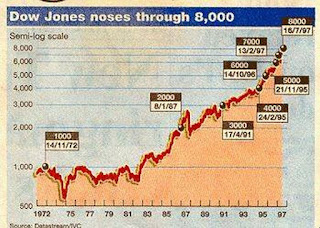
 ... when the inflation-adjusted numbers tell a more dire story  Wall Street doesn’t care about real results so why should they?  Corrected for inflation, real wages have declined  Since March 2021, nominal retail sales have risen 6.9% but are down 4.1% in real terms. Dow Jones, in nominal terms, oscillated around the 1,000 level from the late 1960s to the late 1970s, in real terms it plunged 73.1% from January 1966 to July 1982. The 5% increase in S&P 500 earnings that Wall Street analysts forecast for 2022, as reported by S&P Global, will amount to a real decline.  My earlier forecast of a 40% total drop in the S&P 500 from the early January peak is still relevant.   Gary Shilling Bloomberg 2 september 2022  https://www.bloomberg.com/opinion/articles/2022-09-02/wall-street-is-in-denial-over-the-real-economy Gary Shilling is author, most recently, of “The Age of Deleveraging: Investment Strategies for a Decade of Slow Growth and Defla...

Silicon Valley Bank may be the start of something grimmer

Banking is a confidence trick. Financial history is littered with runs, for the straightforward reason that no bank can survive if enough depositors want to be repaid at the same time.  The trick, therefore, is to ensure that customers never have cause to whisk away their cash.   First, all depositors in svb and Signature would be made whole, and straightaway. Second, the Federal Reserve would create a new emergency-lending facility, the Bank Term Funding Programme. This would allow banks to deposit high-quality assets, like Treasuries or mortgage bonds backed by government agencies, in return for a cash advance worth the face value of the asset, rather than its market value.  Banks that had loaded up on bonds which had fallen in price would thus be protected from svb’s fate. These events raise profound questions about America’s banking system.  Acting as a lender of last resort is one of any central bank’s most important functions. As Walter Bagehot, a former e...

This week you could earn 5.1% on a six-month U.S. Treasury bill, free of state and local tax.

High-quality municipal bonds are yielding the equivalent of roughly 5.5% if you’re in the top federal tax bracket.  You could also buy TIPS (Treasury inflation-protected securities), maturing in 2043, that assure you of a return more than 1.6 percentage points above inflation if you hold for the next 20 years. Rising interest rates should help immunize you against Wall Street’s propaganda that says you need to own junkier bonds to bolster your income. Jason Zweig WSJ 24 February 2023 https://www.wsj.com/articles/welcome-to-the-5-world-where-yield-chases-you-af3df384

There is nothing new on Wall Street.

One of the best books about financial markets was published almost a century ago. “Reminiscences of a Stock Operator”, by Edwin Lefevre A fictionalised account of the exploits of Jesse Livermore, a speculator. Livermore made a fortune selling the market short during the financial panic of 1907. He would repeat the trick in 1929.  There is nothing new on Wall Street. What happens today in the markets has happened before and will happen again. Every extreme of greed or fear has a precedent.  Technology changes, but people do not. Buttonwood The Economist 28 July 2022 https://www.economist.com/finance-and-economics/2022/07/28/reminiscences-of-a-financial-columnist “There’s no recession coming. The pessimistas were wrong. It’s not going to happen,” declared Larry Kudlow, an economic pundit, in December 2007.  Nine months later the staff of the Federal Reserve still thought the economy would grow by 1.5% in 2008.  In fact it shrank by 2.5%, part of the “Great Recession” n...

Hussman Strategic Growth Fund

In the old days, you could blame your stockbroker or fund manager for losing your money. Now that your stockbroker is your phone and your fund manager is an index, it’s a lot harder to point your finger at somebody else. If you’re left with no one to blame but yourself, the obvious way out is denial—especially at times like this, with stocks down about 8% so far in 2022. Individual investors specialize in denial. So do professionals. That’s because of cognitive dissonance, the tension that arises when beliefs and reality collide. You believe you were right to buy that stock; now it’s down 75%, suggesting you might have been mistaken.  Let’s visit John Hussman, portfolio manager of the Hussman Strategic Growth Fund, with roughly $400 million in assets. The fund is up 10% this year, outperforming the S&P 500 by 18 percentage points—but trailed the market in nine of the previous 10 years, according to Morningstar. Jason Zweig WSJ 18 February 2022   https://www.wsj.com/article...

Stocks have rarely been this expensive. That doesn’t (necessarily) mean they’re headed for a crash.

Robert Shiller, a finance professor at Yale University, who won a Nobel Prize in economics in 2013, measures how expensive stocks are by taking the price of the S&P 500 index, dividing by the average of its past 10 years of earnings and adjusting both the price and the earnings for inflation. The gauge is known as the cyclically adjusted price/earnings ratio, or CAPE Today, at a CAPE of 37.1 times adjusted earnings, stocks are significantly above their early record of 32.6 in September 1929 and not far from their all-time high of 44.2 in December 1999.  The respected investor Jeremy Grantham recently wrote that U.S. stocks and other assets are so overpriced that they constitute a “superbubble,” setting up “the largest potential markdown of perceived wealth in U.S. history.” https://englundmacro.blogspot.com/2022/01/jeremy-grantham-says-goldilocks-era-of.html “The problem is, we don’t know,” says Prof. Shiller with a dry laugh. Jason Zweig WSJ 11 Feb.  2022 https://www.wsj....

Forty years ago start of a bull market in bonds. No one saw it coming.

Have I got a deal for you. You can buy mortgage bonds priced to yield 17.85% over the next 10 years or 18.75% over the next 20 years. They’re investment grade, not junk bonds. The only catch? You have to buy them on Sept. 30, 1981. Even today, nobody has a clear explanation of why bonds suddenly seemed more attractive on Oct. 1, 1981, than they had the day before. Because we can see the past as clear as day, it’s all too easy to forget that the future is always enshrouded in fog. “Things can’t go on forever at these rates,” says Mr. Gross. “Interest rates can’t stay this low [net of inflation] because savers, whether it’s Mom and Pop in Des Moines or big pension funds, can’t earn anything on their investment.”  He adds, “For the economy to survive, at some point interest rates have to regain some semblance of an attraction to savers. Otherwise the savings function will be destroyed.” No one knows when that time will come—but come it will. Jason Zweig WSJ Oct. 1, 2021  https://...

You’re Invited to Wall Street’s Private Party.

Bild
  Wall Street is gearing up for a sales push that could enrich the middlemen and impoverish you. I’m talking about private or alternative assets—investments outside the public stock and bond markets.   Jason Zweig Wall Street Journal 20 December 2024 https://www.wsj.com/finance/investing/private-alternative-assets-etfs-cf987342 Tillbaka till Rolfs länktips 20 december 2024 https://englundmacro.blogspot.com/2024/12/rolfs-lanktips-20-december-2024.html

”tja… har man sett en finanskris har man sett alla!”

Bild
Om ämnet kommer upp vid fikabordet kan du helt enkelt slå ut med händerna och säga: ”tja… har man sett en finanskris har man sett alla!” Detta uttalande kommer att få dig att verka världsvan, förhindra vidare konversation (och dessutom vara korrekt.) Finanskriser är nämligen nästan alltid precis likadana. Den klassiska boken om hur de funkar är skriven av ekonomerna Carmen Reinhart och Kenneth Rogoff. Den heter ”Den här gången är det annorlunda”. Det är nämligen vad folk i finansbranschen alltid säger innan en finanskris (åtminstone de senaste 800 åren). Sedan visar det sig att det aldrig är annorlunda. Katrine Marçal DN 16 mars 2023 https://www.dn.se/ekonomi/katrine-marcal-forsta-steget-i-alla-finanskriser-ar-dumhet/ https://www.dn.se/ekonomi/katrine-marcal-hur-ska-bankerna-kunna-gasa-och-bromsa-samtidigt / Carmen Reinhart and I in our 2009 book This Time is Different https://englundmacro.blogspot.com/2011/08/second-great-contraction-kenneth-rogoff.html    Don’t panic. That’s...

Don’t panic. That’s the message financial regulators are sending - FDIC

Throwing a lifeline to the financial system in times of crisis can have unintended consequences.  Among them: Making the world feel safer can lull people into complacency and excessive risk-taking. The attempt to eradicate failure from the financial system, of course, is part of modern society’s broader push to make life itself riskless and idiot-proof As my colleague Greg Ip pointed out in his 2015 book “Foolproof,” however, It also tends to coalesce massive power into the hands of a few people at the pinnacle of the financial system. Former Federal Reserve Chair Alan Greenspan was known as “the Maestro”. After U.S. authorities intervened to help calm a series of financial crises in 1998, Time magazine christened Mr. Greenspan, then-Treasury Secretary Robert Rubin and then-Deputy Treasury Secretary Lawrence Summers the “Committee to Save the World.”  Unfortunately, having some sway over markets can delude regulators and policy makers into believing that they can foresee the f...

Index-Fund Investing Turned Into an Extreme Sport

Bild
  Investing in an ETF that tracks only a few stocks—or even just one—is a lot more exciting than holding an index fund that owns every stock in the market.  It’s also a lot riskier. The median index fund held 503 stocks in 1998, Sotiroff found. By May 2025, that had shrunk to 123 stocks. The more recently an ETF launched, the fewer stocks it tends to own. “A lot of newer investments are taking on more risk than investors may realize,” Let’s be clear: Bundling a limited number of stocks inside an ETF doesn’t make them safe. Fund managers want to earn higher fees than the pittance they can make running an S&P 500 or total stock-market index fund.  And many investors are chasing higher returns—and more excitement than they can get from a traditional index fund—by focusing their bets and taking bigger risks. Jason Zweig Wall Street Journal 11 July 2025 https://www.wsj.com/finance/investing/how-index-fund-investing-turned-into-an-extreme-sport-d555b5ed Retail investors hav...

Whatever Keynes Said, Let’s Follow His Advice

John Maynard Keynes was one of the most influential and also divisive economists who ever lived, but almost everyone cites one of his quotations with approval. “When the facts change, I change my mind. What do you do sir?”  As Jason Zweig of the Wall Street Journal has revealed, it’s not at all clear that the great man ever said this, but we can all agree with the sentiment. That brings us to the events of last Friday.  Everything seemed to point to a decline in job creation. Instead, payrolls added more than 500,000 new workers. That’s very, very unusual. Does all of this make Jerome Powell look silly or smart? It’s important not to be too binary about this. For Blitz, the greatest danger remains that the Fed cuts too much as the economy slows later this year and inflation doesn’t go away. Others take a diametrically opposed view.  Friday’s action in the Nasdaq-100 index, and in the ARK Innovation ETF, which manager Cathie Wood modestly describes as “the new Nasdaq,” was...

For the first couple of weeks of 2023, financial markets were partying as if New Year’s Eve had never ended.

At the beginning of 2023, the market swarm collectively decided that the Fed was bound to retreat from raising rates later this year.  Just like that, the biggest losers of 2021 took off.  Senior Fed officials have said repeatedly they expect to raise the fed-funds rate: around 5%, or more like 6%?”. That’s the interest rate—around 4.3% this week Remember that although interest rates have risen sharply, they’re still moderate by historical standards—and still will be unless the Fed hikes rates far higher than anyone expects.  Jason Zweig WSJ  20 January 2023 https://www.wsj.com/articles/when-the-stock-market-and-jay-powell-are-frenemies-11674229669

Sth 10 mars 2026; TACO, Bobby Ewing

Bild
  Energy Secretary Deletes Tweet Saying U.S. Escorted Tanker Through Strait of Hormuz Vita Huset: USA har inte eskorterat oljetanker Iran’s conventional military has been largely destroyed and it can’t stop US and Israeli air attacks, but... Mining the Strait of Hormuz, using anti-ship missiles against tankers or destroying the Gulf’s oil infrastructure could lead to peace negotiations — or global turmoil, with energy shortages and spiraling inflation.  https://www.bloomberg.com/news/articles/2026-03-10/iran-s-strait-choke-hold-a-potent-weapon-even-as-military-wilts Iran has begun laying mines in the Strait of Hormuz The mining is not extensive yet, with a few dozen having been laid in recent days, the sources said.  But Iran still retains upward of 80% to 90% of its small boats and mine layers, one of the sources said, so its forces could feasibly lay hundreds of mines in the waterway. https://edition.cnn.com/2026/03/10/politics/iran-begins-laying-mines-in-strait-of-horm...