Inlägg

Visar inlägg med etiketten population

World population

Bild
  https://www.postfactum.co.uk/

Burundi

Bild
Burundi an extreme example of how population pressure is changing African societies. For most of history Africa has been sparsely populated, and much of it remains so. But the continent has ten times as many people as a century ago,  78% of farmers own less than a quarter of a hectare of land, about the size of four tennis courts. By 2050, there will be 10m more mouths to feed.  Unless, that is, the fertility rate falls quickly. The Economist 4 January 2026 https://www.economist.com/middle-east-and-africa/2026/01/04/burundi-is-running-out-of-space

Kinshasa, among the fastest-growing cities on Earth

Bild
Africa’s population has doubled in three decades and it’s now home to about 1.5 billion people, a figure that’s predicted to grow to 4 billion by the turn of the century. Nigeria UN data show that the average fertility rate in Africa’s most-populous nation has fallen from six children per woman in 1990 to 4.3 Bloomberg 13 November 2025 https://www.bloomberg.com/graphics/2025-africa-population-jobs/ Godmorgon 14 november 2025 - Buy the dip?

Födelsetal

Bild
  https://www.telegraph.co.uk/news/2025/05/14/demographics-birth-rates-africa-sahel-misery/ By mid-century (2050) Nigeria is projected to be  as populous as the US https://englundmacro.blogspot.com/2022/07/by-mid-century-2050-nigeria-is.html

2050 Africa will be home to approximately 2.5bn people, or around a quarter of humanity

Bild
  By 2030 half of all new entrants into the global workforce will be from sub-Saharan Africa.  By 2050 the region’s working-age population will still be rising when it will be falling everywhere else.  At that point Africa will be home to approximately 2.5bn people, or around a quarter of humanity.   The Economist 6 January 6th 2025 https://www.economist.com/special-report/2025/01/06/to-catch-up-economically-africa-must-think-big By mid-century (2050) Nigeria is projected to be as populous as the US https://englundmacro.blogspot.com/2022/07/by-mid-century-2050-nigeria-is.html

Not since prehistory has there been a time when people were more likely to be born African

Bild
  The total population of its 54 countries has doubled in 30 years, to 1.5bn.  The UN predicts it will double again by 2070. Most of the population growth expected over the rest of the 21st century is expected to take place in Africa.  The Economist 6 January 2025 https://www.economist.com/special-report/2025/01/06/the-economic-gap-between-africa-and-the-rest-of-the-world-is-growing

2019 tourism led to 5.2 gigatonnes of carbon dioxide—almost 9% of the world’s total

Bild
Flygbolaget SAS ska investera i upp till 40 nya flygplan i den största investeringen i företagets historia. 40 stora långdistansflygplan från Airbus. Flygplanen har ett listpris på sammanlagt över 10 miljarder dollar (cirka 97 miljarder kronor), enligt SAS. SAS kontrolleras sedan 2024 av den fransk-nederländska flygbolagskoncernen Air France-KLM. SvT 30 juni 2026 https://www.svt.se/nyheter/inrikes/uppgift-sas-bestaller-nya-flygplan Between 2009 and the start of the covid-19 pandemic in 2020, global emissions from tourism grew by an average of 3.5% a year, double the rate of emissions in general. The Economist 11 December 2024 https://www.economist.com/science-and-technology/2024/12/11/carbon-emissions-from-tourism-are-rising-disproportionately-fast Framtiden för massturism med flyg förefaller inte vara oviss https://englundmacro.blogspot.com/2023/12/framtiden-for-massturism-med-flyg.html Tänk på ett tal. Multiplicera det med 10 miljarder - jordens befolkning 2050 https://englundmacro.b...

A.I. is breaking through at the same moment the international system is breaking down

The revolution in solar energy is a modern marvel, no less transformative or remarkable than the rise of A.I. Breakneck deployment of solar, wind and battery power could decarbonize our economies. The addition of A.I.’s energy demand pushes back the finish line in a race we were already struggling to run In April, the Centers for Disease Control and Prevention announced that the U.S. fertility rate had fallen to a new low of around 1.6 births per woman — well below the 2.1 that is broadly considered an adequate replacement rate.  The European Union average is closer to 1.5, with Germany recently falling below the U.N.’s “ultralow fertility” line of 1.4. South Korea is down to 0.78 Ezra Klein New York Times 12 January 2025 https://www.nytimes.com/2025/01/12/opinion/ai-climate-change-low-birth-rates.html

Sol och vind; kol och olja

Bild
  Mycket att ersätta innan vi är fossilfria. The world has had reliable economic growth for three centuries since industrialization and the fossil fuel era.  Everybody wants to be wealthier and more wealth is correlated with more energy use. Wealth brings more demand for the really poor countries that want to use what we have.  I mean, only one in 700 people in the poor part of the world have ever flown in an airplane. And in the poorest parts of the world, only one in 800 people own a car.  So, you don't have to be a mathematician or an economist to know it doesn't take much growth to create incredible demands for energy to manufacture and operate cars and airplanes,  even if only 10 percentage points more of those people get wealthy enough to want to fly and drive cars. Roughly three billion peoples’ annual energy consumption is equal to the annual energy consumption of your refrigerator.  Their total energy consumption for all purposes over the course of...

All over the world, the total fertility rate (TFR) has been falling since the 1970s

The total fertility rate (TFR) — the number of live children the average woman bears in her lifetime   In one country after another, it has dropped under the 2.1 threshold (the “replacement rate,” allowing for childhood deaths and sex imbalances), below which the population is bound to decline.    This fertility slump is in many ways the most remarkable trend of our era. And it is not only Elon Musk who worries that “population collapse is potentially the greatest risk to the future of civilization.” Our species is not done multiplying, to be sure.   “More than half of the projected increase in the global population between 2022 and 2050 is expected to be concentrated in just eight countries: the Democratic Republic of the Congo [DRC], Egypt, Ethiopia, India, Nigeria, Pakistan, the Philippines and the United Republic of Tanzania.”  When the human population begins to fall, it will do so not gradually, but almost as steeply as it once rose. The problem ...

Människans snabba expansion leder till miljöförstörelse, svält och skövlad biologisk mångfald

I delar av västra Asien och särskilt i Afrika, där befolkningen väntas växa med 2,5 miljarder till 2088 enligt FN, är födelsetalen fortsatt höga.  Folkökningen behöver bromsas snarast för hållbarhet professorerna Malte Andersson och Frank Götmark SvD 2 Januari 2024 https://www.svd.se/a/VPVnOr/jordens-natur-forods-av-folkokningen-skriver-debattorer Fler människor på jorden är inte ett problem, utan gör tvärtom tillvaron bättre för alla .  Mattias Svensson Smedjan 11 December 2023 https://timbro.se/smedjan/overflodet-kan-fortsatta-att-vaxa-hur-lange-som-helst/ Min första artikel i en stor tidning Vad gör vi åt befolkningsexplosionen? Rolf Englund Svenska Dagbladet, Fritt Forum (dåtidens Brännpunkt) 4/8 1967 https://www.internetional.se/wolfsachsdoom.htm https://englundmacro.blogspot.com/search/label/population

The world’s population has reached 8bn. Don’t panic

 On current trends, the global population will reach 9bn in 2037 and peak at 10.4bn sometime between 2080 and 2100. About half the world’s projected population growth between 2022 and 2050 will occur in just eight countries. Five of those are in Africa (Congo, Egypt, Ethiopia, Nigeria and Tanzania).  The other three are in Asia (India, Pakistan and the Philippines). India will probably overtake China as the world’s most populous country next year.  Africa overtook the combined populations of Europe and North America this year (in 1980 it had just one-third of their total).  That will have both environmental and social implications. The Economist 11 November 2022 https://www.economist.com/international/2022/11/11/the-worlds-population-has-reached-8bn-dont-panic

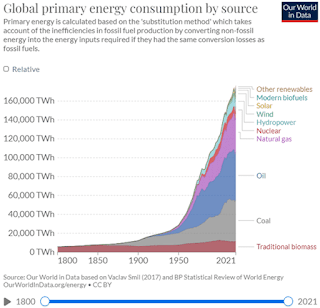
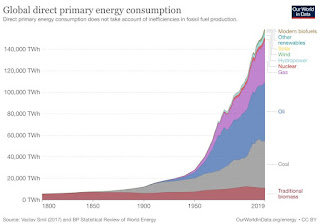
Energy in the future, where will it come from?

Bild
The question is not whether we will use considerably more energy in the future, but where will it come from? Source: Our World in Data Population is projected to grow 25% in the next 25‒30 years. Source: Anthropocene Magazine There is only so much energy that solar and wind can produce in the near term (5‒10 years).  The rest will have to be made up by traditional power sources, some of which are renewable like geothermal and hydro, some of which are carbon free like nuclear, but given the natural limits on production it still means oil and gas will remain a significant contributing factor to our energy usage. John Mauldin 28 October 2022 https://www.mauldineconomics.com/frontlinethoughts/turning-bullish-on-energy#amazing

By mid-century (2050) Nigeria is projected to be as populous as the US

Bild
Africa overtook Asia in 2020 to become the main source of population growth.  The UN reports that more than half of the projected increase up to 2050 will be concentrated in just eight countries, mostly in Africa Globally more than 1bn people will be aged over 65 in 2030 with 210mn aged over 80, about double the numbers in 2010. Older people already account for about a quarter of the population in many countries including Japan, Italy and Germany. UN World Population Prospects report https://population.un.org/wpp/ Global population growth hits lowest rate since 1950 FT 11 July 2022 https://www.ft.com/content/6b131d91-1834-4243-bb8b-dc49060b1450 Global Population Is About to Hit 8 Billion—and Some Argue It Is Near Its Peak “There’s two big questions,” Mr. Lutz explains, that determine whether his forecasts or the U.N.’s end up closer to the mark. “First, how rapidly fertility will decline in Africa…. The other question is China, and countries with very low fertility, if they will re...

Ranked by population, the United States is the world’s third largest country,

 ...  behind China and India. But the gap is greater than the ranking implies. According to Worldometer, as of 2020 China had 1.44 billion people, India 1.38 billion, and the US 331 million. In other words, by population China is more than four times larger than the US. So is India.  Together they represent about 36% of humanity, the US only about 4%.  John Mauldin 21 January 2022 https://www.mauldineconomics.com/frontlinethoughts/beijings-dilemmas

Diagram energi och befolkning

Bild
  Tack till Anders Fischer och Vlade Naumovski

Achieving “net-zero” CO emissions by 2050, by which time the world may have 2 billion more people than it does now

  “keeping the door to 1.5°C open” seems to involve so many moving parts, innovations, adaptations, and, yes, sacrifices, that it is hard to see how it will work without the global carbon price most economists regard as necessary.  In particular, a carbon tax simultaneously incentivizes and coordinates emissions-reduction efforts, and allocates resources accordingly, in ways that state planners simply cannot achieve. The idea of a carbon tax remains political anathema in the United States; it briefly came to the fore in the recent budget negotiations but was dropped like a hot potato. emerging and low-income economies  ask why global climate accords do not push all countries to achieve similar levels of per capita emissions. Because wind and solar are intermittent energy sources, there is a strong case for a renewed push to ramp up nuclear power.  Kenneth Rogoff MarketWatch 2 November 2021 Kenneth Rogoff, a former chief economist of the International Monetary Fund, i...

Lagos is poised to become the world’s biggest city

 A Week in the World’s Most Chaotic City Unending traffic jams, incessant noise and a population of over 20 million people: Lagos is a city on the brink of insanity.  Der Spiegel 30 September 2021 https://www.spiegel.de/international/world/lagos-in-nigeria-a-week-in-the-world-s-most-chaotic-city-a-6d56ae7e-596b-40f1-b1ad-43ba0778a6c7

Sub-Saharan Africa’s working-age population set to double

 The working-age population of sub-Saharan Africa is set to increase more than twofold by 2050 to become the largest in the world, offering unprecedented opportunity for economic growth, according to S&P Global Ratings. “If jobs are not created in tandem, the demographic dividend could become a source of instability, since the relative share of young unemployed people would increase ,” the report said. https://www.cnbc.com/2021/08/06/sp-sub-saharan-africas-working-age-population-set-to-double-revolutionizing-its-economy.html

Joschka Fischer; “systemic” rivalries and great-power politics have no place in an age of climate change

The idea of a Cold War II between the West and China has quickly evolved from a misleading analogy into a self-fulfilling prophecy.  But contemporary China is nothing like the Soviet Union, and in today's world, we simply cannot afford another clash of mutually exclusive systems. Joschka Fischer Project Syndicate 21 June 2021 Nice pic https://www.project-syndicate.org/commentary/cold-war-comparison-misleading-and-dangerous-by-joschka-fischer-2021-06 Africa to propel world’s population towards 10bn by 2050 Sub-Saharan Africa’s population is set to double over the next 30 years, adding an additional 1bn people https://englundmacro.blogspot.com/2019/06/africa-to-propel-worlds-population.html