Inlägg

Consumers surplus förklarar lägre produktivitet ?
Bild
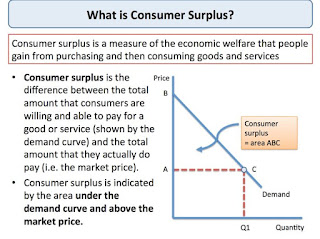
Många oroar sig för den sjunkande produktiviteten i OECD-länderna. Men tänk om det bara är ett räknefel? Om jag fattat det rätt mäter man produktivitet som produktion per mantimme (ursäkta) till marknadspris. Låt oss ta wifi-utrustning som exempel. Den har blivit mycket billigare, eftersom den, liksom de mesta andra varor, produceras allt billigare i Asien. Skillnaden mellan vad vi konsumenter är villiga att betala för wifi, The Sky is the Limit, och vad de faktiskt kostar att köpa hos Kjell, är mycket stor. Min enkla, förhoppningsvis geniala, tanke är att det som framstår som lägre produktivitet i själva verket är en ökning av Consumers Surplus. Kommentarer välkomnas. , https://www.tutor2u.net/economics/reference/consumer-surplus Production is valued at the prices we pay for goods. Take beer.  Count the number of bottles sold, multiply by the price per bottle, and we have the value of beer produced, by the standard definition. That does...

How hard it will be for France to replicate Germany’s transformation

The Economist 27 May 2017

Central banks response to the crisis almost a decade ago is still the key driver of markets

The steady expansion of central bank balance sheets via quantitative easing is still keeping the now-familiar show of equities at record levels and negligible risk premiums firmly on the road. FT 26 May 2017 ZIRP and QE were terrible mistakes

ECB faces impossible choice between German overheating or Italian debt storm Ambrose

When ECB runs out of plausible justifications for why it is still covering Italy's entire budget deficit  and rolling over its existing €2.2 trillion of public debt. Ambrose, 25 May 2017

Riksbanken: Nödvändigt att Riksbanken har en tillräckligt stor valutareserv om det uppstår likviditetsbehov i utländsk valuta som inte bankerna själva kan hantera

Hushållens höga och stigande skuldsättning utgör ett allvarligt hot mot den finansiella och den makroekonomiska stabiliteten.  Det finns även sårbarheter i det svenska banksystemet och dess motståndskraft behöver därför stärkas.  Det gäller såväl bankernas förmåga att hantera likviditetsrisker som deras kapitalnivåer.  Riksbanken Finansiell Stabilitet 24 maj 2017 De svenska storbankerna lånar in korta pengar och lånar ut långa – det klassiska receptet för allvarliga finanskriser. Tidigare hanterades bolånen av särskilda bolåneinstitut. De gav ut bostadsobligationer med mycket långa löptider, som svarade mot låntagarnas amorteringstider.  https://englundmacro.blogspot.se/2017/02/de-svenska-storbankerna-lanar-in-korta.html

Canada household debt has risen to 167 percent of disposable income

As buyers stretch to afford homes, household debt has risen to 167 percent of disposable income -- the highest among the Group of Seven industrialized nations.  Bloomberg 23 May 2017

Will a Smaller Fiscal Deficit Cause the Trade Deficit to Decline or Unemployment to Rise?

However, accounting identities do not tell us the direction in which causality flows, and so all identity-based arguments must implicitly make assumptions about which of the variables drive the other. That is the nub of the claim Shultz and Feldstein make. They argue that if we cut the U.S. fiscal deficit, the U.S. trade deficit must automatically decline. Michael Pettis, The Carnegie Endowment for International Peace 22 May 2017

Greece and its European creditors failed on Monday to agree on the next batch of bailout loans

After more than eight hours of talks in Brussels, finance ministers from the single currency bloc and the International Monetary Fund (IMF) were unable to secure an agreement on the sort of debt relief measures the Athens government can expect when its current bailout program ends next year. Greece could default on its debts in July if it can't repay some 7.3 billion euros Deutsche Welle, 23 May 2017

Monte dei Paschi rescue deal now close

Since the start of 2017, MPS, the Italian government, the European Commission and the European Central Bank’s regulatory arm,  the Single Supervisory Mechanism, have been locked in talks about the design of a rescue. FT 22 May 2017

Münchau: The eurobonds would dismantle the toxic nexus between banks and governments.

The no-bailout rule would suddenly make sense.  This is an environment in which states can default. Wolfgang Münchau, FT 21 May 2017

The End of Theory: Financial Crises, the Failure of Economics and the Sweep of Human Interaction Richard Bookstaber Lucas

As Queen ELIZABETH II famously once pointed out, most economists failed to predict the crisis of 2007-08. In a lecture to the American Economic Association in 2003, Robert Lucas argued that macroeconomics had succeeded in so far as the “central problem of depression prevention has been solved, for all practical purposes”. Yet within five years the world faced its worst crisis since the 1930s. The Economist Print 18 May 2017 When the Queen asked asked an academic at the LSE why the economics profession had failed to predict the credit crunch, she raised a topic which continues to resonate.  Although many answers have been given to Her Majesty’s question, I suspect that none of them has really settled the issue. Her question is disarmingly simple, but the answer is not. Gavyn Davies blog, February 10, 2011

Tett: a sudden recession would create a nasty shock.

The key point is this:  with so much growth already baked into financiers’ forecasts a sudden recession would create a nasty shock. Gillian Tett, FT 18 May 2017

Household debt in the US surpassed its pre-crisis peak in the first quarter

FT 17 May 2017

Wolf: Macron federal agenda even if achievable neither sufficient nor necessary

The truth is that “the euro is incomplete and cannot last without major reforms”.  Thus did candidate Emmanuel Macron warn  Martin Wolf, FT 16 May 2017

Merkel not afraid of treaty changes, but...

“I would be ready to do this, but first we will work on what we want to reform.”  FT 15 May 2017

Six charts show France’s biggest challenges, from rising debt to unemployment near 10 %

Bild
Bloomberg 16 May 2017

The Economist: How the 2007-08 crisis unfolded

The Economist 6 May 2017

Take the cash, hide it in the mattress and wait for the next/coming stock market storm to pass.

Bill Blain via zerohedge May 15th 2017

I Sverige drömmer knappt någon om euron längre, utom möjligtvis Liberalerna – och debattören och författaren Per Wirtén.

Joseph Stiglitz, före detta chefekonom på Världsbanken och rådgivare till amerikanska regeringar, tvingas i sin nya bok Euro – hur en gemensam valuta hotar Europas framtid, konstatera att en fullständig ”brist på empati” präglar eurons politiska förespråkare. Per Wirtén drömmer om ett enat, federalt Europa, ett Europas förenta stater. Kärnan i den drömmen är just den euro som Stiglitz sågar med fotknölarna. Känslan är stark av att Wirtén inte greppat vidden och djupet av den katastrof som eurosystemet faktiskt ställt till med. Och hans lösning är att göra EU:s institutioner mäktigare. Göran Greider, Aftonbladet  15 maj 2017 Per Wirtén,  ”Är vi framme snart? Drömmen om Europas förenta stater”, Albert Bonniers förlag Mr Stiglitz presents the euro story as mostly tragedy:  “It was created with the best of intentions by visionary leaders whose visions were clouded by an imperfect understanding of what a monetary union entailed.”  https://eng...

In 2016, Germany ran a current-account surplus of roughly $ 297 billion, or 8.6% of GDP

Changing the exchange rate would not diminish the incentive for Germans to save. In the current European environment of near-zero interest rates, there’s little risk that additional public investment will crowd out private investment.  Barry Eichengreen, Project Syndicate 14 May 2017