Inlägg

Visar inlägg som matchar sökningen efter Merryn Somerset Webb

We have reached the bad-news-is-good-news part of this cycle. Merryn Somerset Webb.

Bild
We have reached the bad-news-is-good-news part of this cycle. Some may remember this from previous market debacles. Think 2006. Any hint of a slowdown in the economy was greeted with great joy. It meant that, even with inflation consistently running above target, interest rates might not rise and stocks therefore not fall.  That bit may come around again. Maybe soon. We have other bits of bad news we can make good. Here’s US strategist Ed Yardeni on artificial intelligence:  “We view investors’ growing concerns about the AI boom as good news... The AI rollercoaster may be hitting speed bumps, but that will help keep it on a steadier path.” The availability of the capital required for the AI buildout plus the dawning realization that this is as much an earnings bubble as a valuation bubble could be a problem. In past industrial revolutions, the job losses have crowded at the bottom of the income pile. This time around, not so much. AI isn’t going to put plumbers out of work....

Merryn Somerset Webb: Will We Ever Learn to Avoid Bubbles?

Bild
The same thing happens over and over again. There’s a great story. Everyone loves the story. Everyone buys. The reality doesn’t quite match the story. The asset class collapses.  It isn’t hard to spot a bubble forming. But experienced investors will know it’s very very hard to spot when it might finally come a cropper. That’s partly because it doesn’t really need a catalyst;  it doesn’t require political disruption, financial scandal or shifts in monetary policy.  The end, as Societe Generale AG’s Albert Edwards points out, is often remarkably simple: “A reversal in price momentum in an asset class that has risen sharply for a number of years (sucking in huge quantities of loose money) is often sufficient in itself to cause prices to crash.” When there is no one left to buy or when a few of those who might have already bought become a little nervous, it all comes crashing down.  In that sense, you could think of all bubbles as a type of (legal) Ponzi scheme ChatGPT a...

Proper bubbles involve people convincing themselves that a high-profit, low-inflation environment will be permanent

Periods of extreme valuation in the stock market don’t really happen very often.  The basic driver has been much the same: the ability of investors to believe absolutely in something that always turns out to be impossible.  This always ends badly. Think 1901, 1921, 1929, 1966, 2000, 2007, briefly 2020 and possibly right now. The only question is how fast it ends badly.  Price-to-earnings ratio at about 40, more than double its long-term average. Merryn Somerset Webb FT 28 Januay 2022 https://www.ft.com/content/0f763575-ac5f-4a20-a6a8-279e4613e048   US market is more overvalued than in 1929, 1973 and 2007  Merryn Somerset Webb FT 28 December 2021 https://englundmacro.blogspot.com/2021/12/us-market-is-more-overvalued-than-in.html   Sommaren 1991 hälsade jag på min gamle gode vän Sven Rydenfelt. Vi talade om fastighetskrisen som då startat på allvar, och den tanklösa överbelåningen. Ja, det är ju märkligt att människor inte tänker på vad som hände 1907, sa Ryd...

Don’t count on Fed to ride to the rescue of a faltering stock market -- at least not yet

 That’s not encouraging for investors betting on the imminent exercise of a “Fed put” -- in which the central bank alters policy to prop up equity markets after a sharp decline.  Bloomberg Economics Says... “I think the Fed welcomes it. The stock market has to decline a lot more -- double the current drop -- before it will get close to wiping out the stock gains during the pandemic. This sounds callous, but declining stocks will get more people to come out of early retirement.” --Anna Wong, chief U.S. economist Bloomberg 19 May 2022 https://www.bloomberg.com/news/articles/2022-05-19/fed-plans-for-half-point-hikes-won-t-be-shaken-by-stocks-rou t If you have only been in markets for, say, 15 years,  you are seeing the collapse of everything that you have been told is true and have also observed to be true about markets. Bonds prices rising in the bad times. Mostly when things look tricky in equity markets there is a reason (or central banks at least manage to find one) to c...

Arthur Burns “The Anguish of Central Banking”

Contrary to the belief of most central bankers, there is no definitive model that works: “monetary theory . . . does not provide central bankers with decision rules that are at once firm and dependable”, as Burns put it. We might know that “excessive creation of money” will cause inflation, for example, but this knowledge “stops short of mathematical precision”. The result? Surprises and mistakes at “every stage of the process of making monetary policy”. In the audience in Belgrade sat Paul Volcker A few years later Volcker gave a talk titled “The Triumph of Central Banking?” No wonder today’s central bankers all want history to remember them as a Volcker not a Burns. But note the question mark in his title.  Merryn Somerset Webb FT 23 September 2022 https://www.ft.com/content/ac786b9e-be5a-4b8a-87b0-bc020a28f5c5 The writer is editor-in-chief of Money Week Powell Burns Volcker https://englundmacro.blogspot.com/2022/06/powell-burns-volcker.html If you have only been in markets for, ...

After every bubble, we need to relearn the basics. Here is some essential reading

Robin Angus’s anthology of his own writings — “A Shared Journey: Extracts from Personal Assets Trust Quarterly Reports 1994-2021.”  It is gorgeously written, quite funny and jammed with pure investing common sense. As a bonus you will find other books with utility value suggested along the way.“ “The End of the Everything Bubble” by Alasdair Nairn published it in October 2021 — that’s the kind of timing you don’t often see from fund managers.  Next is “The Price of Time” by Edward Chancellor , the story of how negative interest rates, “the craziest innovation in finance” in 5,000 years, gave us one of the greatest asset bubbles ever, by taking out the anxiety (and hence care) that should be associated with borrowing.  “The Money Game” by Adam Smith (actually George Goodman) was first published in 1967, but every word is as valid now as then. There’s much on the emotions and psychology of markets. Merryn Somerset Webb Bloomberg 23 december 2022 https://www.bloomberg.com/...

US market is more overvalued than in 1929, 1973 and 2007

On a cyclically-adjusted price/earnings ratio, the US market is more overvalued than in 1929, 1973 and 2007. Inflation is rising, central bank stimulation fading and Omicron is upsetting the already fragile apple cart. Not exactly the Goldilocks scenario is it? The relative case for equities — that they are at least cheap relative to bond yields — also won’t last long when bond yields start to rise. 2022 looks like it comes with an unusually wide range of possible outcomes. Merryn Somerset Webb FT 28 December 2021 https://www.ft.com/content/307f729c-4ada-445c-a2cd-e1caa2e99e0c Turn off the liquidity taps and the ability to believe the impossible evaporates Merryn Somerset Webb FT 26 October 2018 https://englundmacro.blogspot.com/2018/10/turn-off-liquidity-taps-and-ability-to.html

How Much Damage Have Central Bankers Done?

A Lot. This columnist’s book selections highlight the wreckage of ultra-loose monetary policy. First up, someone must have a copy of You Always Hurt the One You Love: Central Bankers and the Murder of Capitalism by Bernard Connolly.  You might not need much more than the title to get your row going. But it’s worth reading on to nail down exactly why central bankers are almost entirely responsible for asset bubbles “unsupported by realistic expectations of future productivity,” along with recent financial crises and disruptive wealth inequality.  For more on how it’s all central bankers’ fault, follow Connolly with Edward Chancellor’s excellent The Price of Time, a history of interest rates.  Distort the price of money, says Chancellor, and you distort the price of time, the present and the future move “out of whack.” Overly low rates are in effect a type of “loan forbearance” that encourages investment and then traps capital in low- (or no-) return areas, something that h...

Ändå står Stockholmsbörsen tre gånger högre

Bild
  Under de senaste 15 åren har vi genomlidit en finanskris, en europeisk skuldkris, Brexit, en stökig president i USA, ett elakt virus och en inflationschock.  Ändå står Stockholmsbörsen tre gånger högre.  Strax efter finanskrisen skrev jag min första krönika i Di. I dag skriver jag den sista.  Lehmankraschen och efterspelet av den blev också förspelet till den europeiska skuldkrisen som eskalerade med Grekland Slutpunkten för skuldkrisen blev den 26 juli år 2012 när dåvarande ECB-chefen Mario Draghi kallade till en presskonferens och bedyrade att ECB kommer att göra ”whatever it takes” för att säkerställa att valutaunionen håller och att inget land tvingas ställa in sina betalningar (finare ord för att gå i konkurs). Så löstes, som bekant, skuldkrisen genom att den offentliga sektorn på överstatlig nivå lånade ut mer pengar till de länder som hade fallit ner i skuldfällan.  Det visade sig vara ett korkat beslut av Storbritannien att gå ur EU, men både unionen o...

2022 looks like it comes with an unusually wide range of possible outcomes.

Merryn Somerset Webb FT 28 December 2021, Repeat 2021 https://englundmacro.blogspot.com/2021/12/us-market-is-more-overvalued-than-in.html Merryn Somerset Webb is  Editor in chief of Moneyweek, the best selling financial magazine in the UK, and a contributing editor at the Financial Times where she has a weekly column. Börsen 2022 i Stockholm och New York https://englundmacro.blogspot.com/2022/12/borsen-2022-i-stockholm-och-new-york.html

Jeremy Grantham Warns US Stocks Are About to Be Crushed

Bild
The famed value investor says on this week’s Merryn Talks Money that a “major decline” is imminent.  “The longer and the higher they climb, the worse it is.” In this week’s episode of Merryn Talks Money, host Merryn Somerset Webb interviews GMO co-founder and notorious caller of market bubbles Jeremy Grantham. Bloomberg 28 February 2025 https://www.bloomberg.com/news/articles/2025-02-28/podcast-gmo-s-jeremy-grantham-on-super-bubbles-ai-fertility Jeremy Grantham on my blogg https://englundmacro.blogspot.com/search?q=Jeremy+Grantham+ SvD 16 februari 2025 https://englundmacro.blogspot.com/2025/02/vad-hander-egentligen-med-ekonomin-nar.html Tillbaka till Rolfs länktips 28 Februari 2025 https://englundmacro.blogspot.com/2025/02/rolfs-lanktips-28-februari-2025.html

Japan

Bild
Japan Bring Money Back Home As a percent of GDP, Japan holds more assets abroad than any developed economy. Can dinner in the New Otani garden’s teppanyaki restaurant really cost much the same as it did when we were young foreign brokers? Renting an apartment in Tokyo will cost you only 25% of the same in New York. Buying one will cost half the price of one in London. What’s going on? It’s mostly about the yen at 40-year lows. Along the way it has eroded the purchasing power of its older generation, but also protected a highly sophisticated manufacturing base, securing a level of intergenerational fairness few others have managed (for how not to do this, see the UK).  The key point: the devaluation of the yen was deliberate (see my colleague John Stepek on this here) https://www.bloomberg.com/news/newsletters/2026-07-14/japanese-yen-may-not-remain-a-bargain-for-much-longer Finance Minister Satsuki Katayama. Perhaps, she said, now might be a good time to encourage local investors, a...

Who’s afraid of 2.1% inflation?

 Back in the old days — the ones younger readers may not even remember — interest rates were generally higher than inflation.  For years now, asset markets have been all about working with falling inflation and interest rates with a vast side order of quantitative easing (QE). There is no bigger deal than that changing Merryn Somerset Webb FT 18 June 2021 https://www.ft.com/content/1d3f83a8-4044-4c9d-a7b4-1aafbfbedf88 Real men are not afraid of a little inflation. But they are scared of stagflation https://englundmacro.blogspot.com/2021/06/real-men-are-not-afraid-of-little.html

Turn off the liquidity taps and the ability to believe the impossible evaporates

When money is constantly cheap and available everything seems straightforward.  Markets go up whatever happens, leaving investors free to tell any story they like about why.  It is easy to believe that tech companies with profits in the low millions are worth many billions.  Or, as one fund manager told me last month, that traditional equity valuation methods are no longer the point Merryn Somerset Webb FT 26 October 2018

The once-a-decade headline would be a given: “Interest rates go negative.”

The fall in interest rates over the past 40 years is the story that, along with its brother in arms, money printing, explains all other financial stories.  Merryn Somerset Webb FT 14 May 2021 https://www.ft.com/content/3be9697a-d13b-4e5f-b960-14f587f8c820

Markets Pray for a Goldilocks Economy

Bild
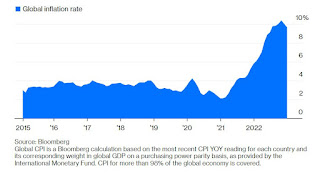
Not too hot, not too cold? Not likely. Overly-hot wage increases keep central bankers awake at night. This is how inflation expectations get embedded into economic behavior. It is devilishly hard to prevent a self-perpetuating spiral, where increased living costs lead to ever higher-demands for salary improvements. Average hourly earnings can, in normal times, comfortably hover a bit above the Federal Reserve's 2% inflation target. But the number has been running at more than 5% for over a year. Until this crucial measure comes back under control, the Fed can't stop hiking interest rates. Stagflation looks like the most likely outcome, at least for the first part of this year. Marcus Ashworth and Mark Gilbert Bloomberg 3 januari 2023  https://www.bloomberg.com/opinion/articles/2023-01-03/market-charts-to-guide-investors-into-2023-plus-an-ai-cat-bot US market is more overvalued than in 1929, 1973 and 2007 Not exactly the Goldilocks scenario is it? Merryn Somerset Webb FT 28 Dece...

Interest rates are still almost ridiculously low by historical standards

Overall it seems obvious that this house price boom must end — and soon.  Or not.  The last time inflation was this high, the base rate was 10 per cent.  Today, if you have a deposit of 40 per cent or more you can get a 10-year fixed-rate from Halifax at 2.48 per cent.  Have 25 per cent and the rate goes to 2.58 per cent. Long-term borrowing at 5.5 percentage points below the rate of inflation? That is as close to free money as you are going to see this year. House prices to fall? Definitely, but not quite yet. While values are high, real interest rates are negative, making homes surprisingly affordable. Merryn Somerset Webb FT 15 April 2022 https://www.ft.com/content/54f979d1-5d71-4e0b-88d9-ba6f2c8eb745 Min gissning är att  de rörliga boräntorna toppar på 3-3,5 procent.   Det blir kännbart, men vi överlever. Räntechocken uteblir. Henrik Mitelman DI 11 april 2022 https://englundmacro.blogspot.com/2022/04/den-tongivande-medelklassen-i-sverige.html

Stefan Ingves, Viktor Munkhammar och Centralbankernas konspiration

 Enligt skolboken ska en centralbank inte bry sig om prisförändringar på sådant som energi och livsmedel, säger Viktor Munkhammar i en fråga till Stefan Ingves. Ändå höjer centralbankerna världen över nu ränteläget (utom ECB som först måste hitta på en metod att höja räntan utan att Italien går i konkurs och spräcker euron). Varför? Headline inflation är nu hög och svider i konsumenternas plånböcker. Alla vet att nu är det inflation. Se där ett gyllene tillfälle för centralbankerna att höja räntan och därmed sätta stopp för den långvariga skuldökningen hos hushåll och företag.  --- Stefan Ingves ”Vi har haft en lång diskussion i många centralbanker på temat att många av de prisuppgångar vi har sett har varit av övergående karaktär. Men det här övergående har dragits ut i tid väldigt mycket mer än vad vi trodde tidigare. Dessutom har inflationen blivit högre än vi trodde tidigare. Då har jag och flera av mina kolleger sagt att det uppenbara med facit i hand är att vi är någon a...

19 juli. Börsen vände upp när marknaden trodde det skulle bli fred snart.

Bild
  The US and Iran engaged in another wave of tit-for-tat attacks, with US forces hitting Qeshm Island and southern cities in Iran, and Iran retaliating with drone strikes targeting US forces in Kuwait. The US embassy in Jordan said the airport and sea port at Aqaba had been evacuated due to a "specific and credible threat", but Jordanian authorities denied this and said operations continued as normal. The targeting of civilian infrastructure, including bridges, utilities and port facilities, has expanded beyond strictly military targets, with Saudi Arabia, the United Arab Emirates and Qatar expressing concern over the latest escalation. Bloomberg 19 July 2026 https://www.bloomberg.com/news/articles/2026-07-19/us-iran-trade-more-attacks-after-two-troops-killed-in-jordan US troop deaths raise fears of a wider war as Iran hit by new strikes Jordanian airport and seaport were evacuated due to a 'specific threat,' as Kuwait and Bahrain intercept Iranian attacks. CNN 19 Jul...

Negative rates also destroy the stability of pension and insurance funds.

If negative rates cause the next crisis by distorting capital allocation and encouraging unmanageable levels of debt, central bankers will discover that the real danger is to them personally.  The whole idea that they are politically independent good guys will come tumbling down. Merryn Somerset Webb FT 4 October   The writer is editor in chief of MoneyWeek